
Bare metal hosting is what you move to when “good enough” performance and control stops being good enough—and when you need predictable, low p95/p99 latency instead of hoping your virtual neighbors behave.
If you’re running latency-sensitive apps, training AI models, dealing with strict compliance requirements, or just tired of noisy neighbors on shared infrastructure, renting the entire physical server—no hypervisor, no shared resources—is often the smartest move. You get consistent performance, predictable resource usage, and full control over the operating system and stack, including kernel-level tuning, NUMA pinning, and specialized storage layouts you can’t reliably pull off on multi-tenant cloud VMs.
With dedicated and bare metal infrastructure seeing a real resurgence for AI, real-time analytics, and compliance-heavy workloads, choosing the right provider matters more than ever. The wrong choice can leave you overpaying for idle capacity, stuck on old silicon for years, fighting with limited support, or locked into regions that don’t match where your users and regulators actually are.
Below, you’ll find a breakdown of the best bare metal hosting services right now, starting with Atlantic.Net (a strong first stop if you care about compliance and hands-on support), plus several other options that fit different use cases, operating models, and budgets—from hourly bare metal cloud to ultra-budget European root servers.
A 10-Minute Bare Metal Fit Test (No Guessing Required)
This quick self-assessment is built to prevent two common mistakes: (1) paying for bare metal when a well-chosen VM (or dedicated plan) would have been fine, and (2) staying virtual when tail latency, jitter, or isolation is already hurting production.
| Question | Score | Why it matters |
|---|---|---|
| Do you care about p95/p99 latency more than averages? | 0 / 1 / 2 | Tail latency is where shared contention and scheduling variance shows up first. |
| Have you seen production issues that look like jitter (spikes), not steady slowness? | 0 / 1 / 2 | Jitter is a classic symptom of unpredictable contention and “neighbor” effects. |
| Do you need hardware-level isolation for compliance/security posture? | 0 / 1 / 2 | Single-tenant hardware often makes isolation and audit narratives simpler. |
| Do you need kernel/OS control (custom modules, tuned kernels, IRQ tuning, hugepages, etc.)? | 0 / 1 / 2 | Deep tuning is more repeatable when the hardware topology is stable. |
| Are your workloads CPU-cache sensitive (real-time analytics, ad tech, game backends, inference-heavy services)? | 0 / 1 / 2 | Cache behavior and consistent scheduling can matter more than raw “core count.” |
| Are you already paying for “special VM types” (dedicated cores, isolated instances)? | 0 / 1 / 2 | At that point, bare metal can be simpler and sometimes more cost-effective. |
| Is your storage I/O profile heavy and predictable (databases, logging, OLAP/ETL, ML pipelines)? | 0 / 1 / 2 | Predictable I/O paths make it easier to control p95/p99 performance. |
| Do you require specific hardware layouts (NUMA pinning, local NVMe, custom RAID/ZFS, CPU model constraints)? | 0 / 1 / 2 | This is where bare metal stops being a preference and becomes a requirement. |
| Can the team operate it (patching, monitoring, backups, incident response)? | 0 / 1 / 2 | Bare metal rewards ops maturity; managed options reduce operational load. |
| Is this a stable footprint for 12–36 months (not short-lived burst capacity)? | 0 / 1 / 2 | Bare metal is strongest when the goal is consistency, not rapid churn. |
How to interpret your score:
- 0–7: Bare metal likely isn’t necessary yet. Architecture, caching, query patterns, and VM selection usually deliver bigger wins.
- 8–13: Bare metal can make sense if the pain is tail latency/jitter, isolation, or deep tuning—and the ops model can support it.
- 14–20: Strong bare metal fit. The stability and control typically outweigh the tradeoffs.
One mental model to anchor this decision: optimize for percentiles (especially p95/p99), not averages. Tail latency is what users feel. Google’s SRE guidance is one of the clearest explanations of how to think about latency distributions in production systems: https://sre.google/sre-book/monitoring-distributed-systems/.
Bare Metal Reality Check: What You Gain (and What You Now Own)
- You gain: stable performance, consistent CPU topology, predictable I/O, full OS/kernel control, true isolation.
- You take on: patch discipline, monitoring maturity, backup/restore ownership, and “hardware is real” failure modes (dead SSDs, flaky NICs, RAM errors).
- Best compromise when help is needed: managed bare metal or a provider that can do hands-on support/remote-hands quickly without drama.
Quick Tuning Wins That Actually Move p99 (When It’s Worth Tuning)
Kernel-level tuning, NUMA pinning, and specialized storage layouts are the “adult” levers—but they only pay off after the basics are stable. These are the tuning areas that most often move low-latency performance, with primary references so the guidance stays grounded:
The workflow that keeps tuning honest is always the same: establish a baseline, change one thing, and re-test (especially for network and storage).
The Best Bare Metal Hosting Services
If you just want the short version:
- Atlantic.Net – Best overall (especially if you care about compliance, change-controlled environments, and hands-on support)
- Hivelocity – Best for globally distributed bare metal with fast deploys, deep automation, and “bare metal as code” workflows
- Liquid Web – Best fully managed bare metal for businesses that want white-glove support and a true extension of their ops team
- OVHcloud – Best DDoS-hardened bare metal for value pricing and Internet-facing workloads
- phoenixNAP – Best API-driven bare metal cloud with hourly billing and CI/CD-friendly provisioning
- Hetzner – Best budget bare metal for European workloads and side projects that still need serious hardware
If you’re not sure whether you need bare metal vs. traditional dedicated hosting, here’s the simplest way to think about it:
- Choose bare metal when you need maximum performance, hardware-level control, or strict isolation for compliance and security—things like running your own hypervisor, pinning vCPUs to specific cores, or isolating sensitive data to a single-tenant box.
- Choose standard dedicated when you want similar isolation, but with more out-of-the-box management, cPanel/Plesk-style tooling, and slightly less concern about squeezing every last drop of performance from the hardware.
Let’s walk through each provider, when they make sense, and where they might fall short so you can pick the right fit the first time—and avoid an expensive migration in 18 months.
Atlantic.Net – Best Bare Metal Hosting for Most
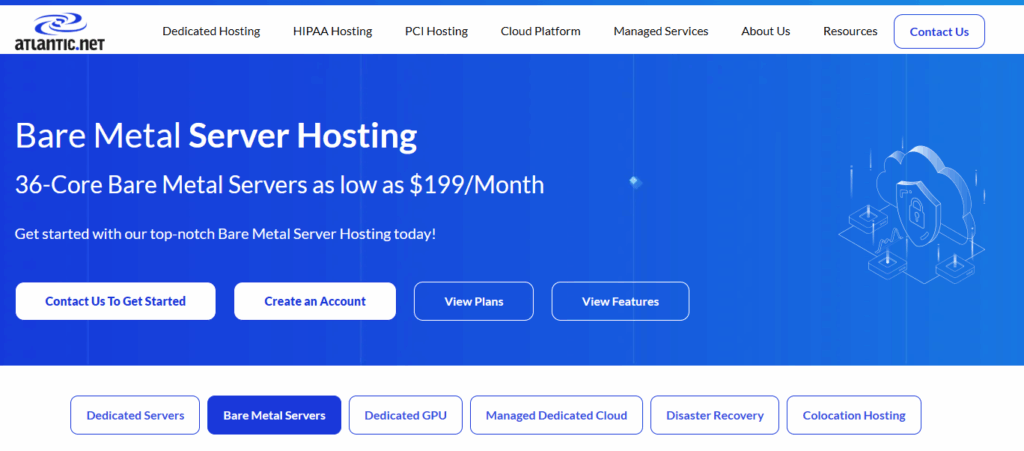
Atlantic.Net puts bare metal front and center for organizations that care about performance and regulatory requirements. You get high-end Intel Xeon and AMD EPYC configurations (including 36-core and 64-core options) with SSD or NVMe storage, 20 TB+ bandwidth on 1 Gbps ports, and aggressive pricing that often starts in the low-$100s per month on promo plans—without forcing you into a huge hyperscaler contract.
What really separates Atlantic.Net is the combination of infrastructure, compliance, and support:
- They back their infrastructure with a 100% network and infrastructure uptime SLA, which is rare at this price point and gives you a clear baseline for availability-sensitive workloads.
- Their data centers and hosting offerings support HIPAA, PCI DSS, SOC 2, and SOC 3 compliance, making them a strong fit for healthcare, finance, and other regulated industries where you’ll eventually be asked for audit trails and Business Associate Agreements.
- Bare metal is available out of data centers in key U.S. metros like New York, Dallas, Ashburn, Orlando, and San Francisco, with extended reach into Canada, Asia, and Europe—useful if you’re trying to keep PHI or card data inside specific jurisdictions.
Where Atlantic.Net shines
- Compliance-ready environments – If you need HIPAA, PCI, or SOC-aligned hosting, Atlantic.Net has a long track record and audit-ready infrastructure to back it up. They’re used to working with healthcare apps (EHRs, HL7/FHIR integrations, PACS image archives) and fintech platforms that need strict segregation.
- Strong out-of-the-box hardware – Multiple pre-built plans from 6-core Xeon E-series up through 64-core EPYC, with generous RAM and SSD/NVMe storage options. It’s easy to match a plan to specific database, analytics, or AI workloads without reinventing the wheel.
- Custom builds and scaling – Don’t see what you want? You can request custom bare metal configurations tailored to your workload, including extra RAM-heavy builds, storage-heavy nodes, or clusters designed for high availability.
- U.S.-based, always-on support – 24/7/365 support with phone access and a heavy focus on helping customers design compliant, high-availability architectures—not just rebooting servers when something goes wrong.
Choose Atlantic.Net if: you want serious bare metal performance wrapped in compliance, documentation, and a 100% SLA. It’s especially compelling if your business is in healthcare, finance, or ecommerce and you want bare metal that won’t turn into a compliance headache or unplanned audit fire drill later.
Hivelocity – Best for Global Bare Metal at Scale
Hivelocity brands itself as the “bare metal cloud company,” and it fits: you get 50+ global data centers, instant-deploy servers, and a strong API-driven platform that makes it easy to automate large fleets of physical machines. Think of it as cloud-style operations running on single-tenant hardware.
It’s a good fit if you want bare metal performance with cloud-like orchestration—especially if you already manage infrastructure via Terraform, Ansible, or similar tooling and want bare metal to plug into the same pipelines.
Where Hivelocity shines
- Fast provisioning – Popular configurations can be deployed in as little as 7 minutes, with most instant-deployment servers ready in under 20 minutes. That’s a big deal when you’re spinning up new regions or scaling a campaign on short notice.
- Deep automation – Robust REST API plus integrations with tools like Terraform and Ansible make it easy to treat bare metal as code: you can version control entire clusters and re-create them on demand instead of manually ordering and configuring servers.
- Global footprint – Great if you need low-latency presence across North America, Europe, and beyond, especially for gaming, streaming, ad tech, or SaaS workloads where “close to the edge” actually matters.
- In-house 24/7 support – Hivelocity emphasizes that it does not outsource support; you get staff on-site in their U.S. data centers who can handle hands-on tasks like drive swaps and private networking changes.
Where Hivelocity might fall short
- Less compliance marketing than Atlantic.Net or Liquid Web – You can absolutely build secure, compliant setups, but Hivelocity doesn’t lead with HIPAA/PCI messaging the same way Atlantic.Net does, so documentation and design may require more internal ownership.
- More DIY on architecture – It’s powerful and flexible, but best suited to teams that are comfortable planning their own network topology, redundancy, peering, and security controls.
Choose Hivelocity if: you care about global reach, fast provisioning, and strong automation more than you care about having a hand-holding compliance partner. It’s ideal if “bare metal” for you means “another target in our IaC repo,” not a one-off snowflake server.
Liquid Web – Best Managed Bare Metal for Growing Businesses
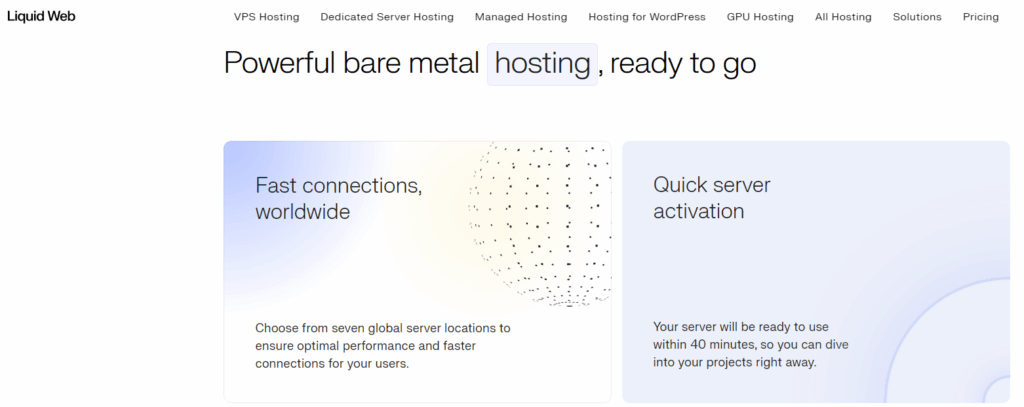
Liquid Web’s bare metal servers are designed for customers who want dedicated hardware plus serious managed support. Plans run on high-end hardware (NVMe SSDs, modern Xeon Gold processors, high-bandwidth connections) and are spread across multiple data center locations, giving you good geographic redundancy.
Where Liquid Web stands out is its managed hosting focus—you can offload a lot of system administration, monitoring, and backups to their team instead of building out a 24/7 internal ops function.
Where Liquid Web shines
- Full single-tenant performance – You get a dedicated physical machine with direct hardware access and no virtualization layer, which is ideal for big databases, analytics workloads, and high-traffic apps that need stable performance during traffic spikes and marketing campaigns.
- Managed services available – Liquid Web offers managed tiers that cover OS patches, security hardening, monitoring, and backups if you don’t want your team dealing with all of that. For many growing businesses, that’s cheaper than hiring senior infrastructure engineers in-house.
- Compliance-friendly – They highlight use cases in finance, healthcare, and retail that need strict security and compliance, and pair bare metal with HIPAA and PCI hosting options so you’re not stitching together compliance on your own.
Where Liquid Web might fall short
- Pricing is on the premium side – You’re paying for managed support and higher-end infrastructure. If you’re strictly optimizing for price per core or building a giant fleet of ephemeral nodes, there are cheaper options.
- Less “pay by the hour” flexibility – Compared to bare metal cloud platforms like phoenixNAP, Liquid Web is more traditional in its billing and contract structure, which is perfect for long-running production apps but less ideal for short-lived test clusters.
Choose Liquid Web if: you want bare metal performance but also want a provider that handles most of the heavy lifting on management, security, and support. It’s a solid option when uptime and peace of mind matter more than shaving every last dollar off the infrastructure bill.
OVHcloud – Best DDoS-Protected Bare Metal for Value Pricing
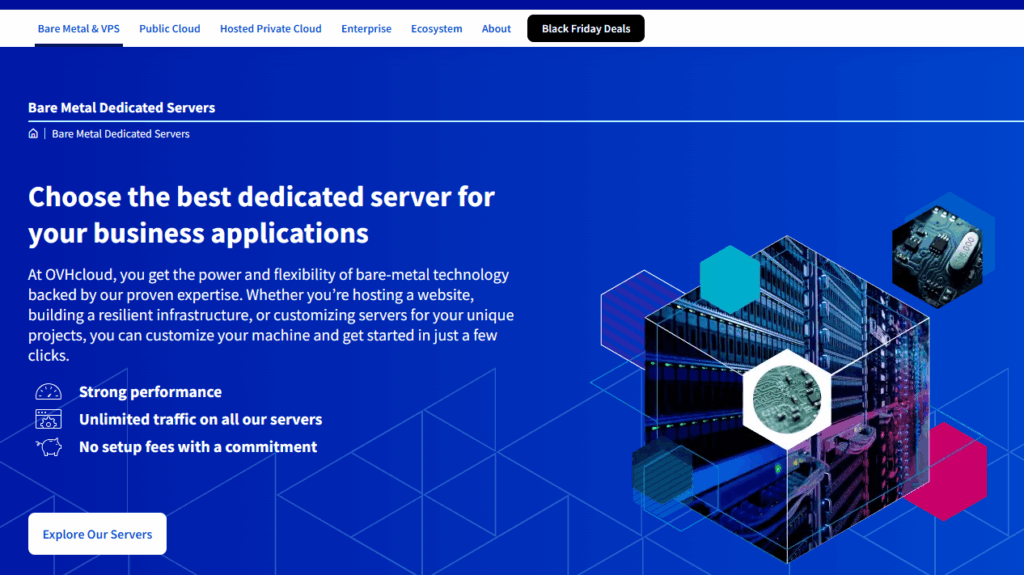
OVHcloud is one of the most popular bare metal providers globally, especially for cost-conscious deployments. Their dedicated/bare metal servers come with:
- Built-in anti-DDoS protection on every server, tuned for high-volume, network-level attacks
- SLAs ranging from 99.90% to 99.99% uptime, depending on the server range
- Global data centers with strong presence in Europe and North America
OVHcloud is especially appealing if you’re dealing with DDoS-prone workloads like gaming servers, exposed APIs, or high-visibility applications and want protection included by default instead of bolt-on mitigation.
Where OVHcloud shines
- Anti-DDoS included – You don’t pay extra for the core DDoS mitigation infrastructure; it’s built into the platform and capable of handling very large attacks, which is attractive if you’re running public game servers or SaaS apps that occasionally end up on the wrong side of the internet.
- Good price-to-performance – OVHcloud’s dedicated/bare metal pricing is usually aggressive compared to U.S. premium managed providers, especially for CPU- and bandwidth-heavy workloads.
- IPv4 and IPv6 support – Each server includes both, with options to rent additional IPv4 addresses up to a sizable limit, which is handy if you’re hosting many distinct services or customers.
Where OVHcloud might fall short
- Support expectations – OVHcloud is more “infrastructure first” than “white-glove managed.” Expect to handle more system administration, monitoring, and incident response.
- More self-managed experience – Great for teams that are comfortable with Linux, networking, and automation; less ideal for those who expect managed support similar to Liquid Web or Atlantic.Net.
Choose OVHcloud if: you want solid bare metal with built-in DDoS protection and strong value pricing, and you’re comfortable running your own stack and monitoring.
phoenixNAP – Best API-Driven Bare Metal Cloud with Hourly Billing
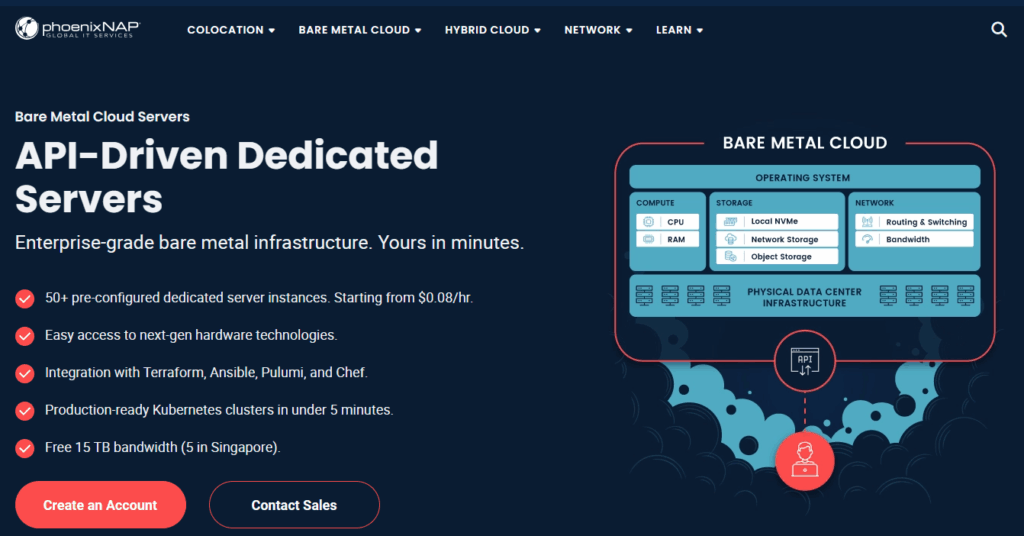
phoenixNAP offers a Bare Metal Cloud platform that sits somewhere between traditional dedicated hosting and public cloud: you get true bare metal servers, but with API, CLI, and web UI–driven provisioning, global locations, and flexible hourly or monthly billing.
This makes phoenixNAP attractive for AI workloads, CI/CD pipelines, ephemeral environments, and high-traffic apps where you want raw performance but still need to scale up and down quickly. It’s especially handy when you want to schedule short bursts of GPU or CPU capacity for training runs or load tests without keeping expensive hardware powered on all month.
Where phoenixNAP shines
- Cloud-like consumption of bare metal – Spin up pre-configured dedicated servers in minutes via API or UI, and pay by the hour or month. It can plug into existing DevOps pipelines with minimal friction.
- Aggressive entry-level pricing – General-purpose instances start as low as $0.08/hour or under $40/month, with more powerful configurations still competitive compared to mainstream clouds.
- Global locations – Data centers in the U.S., Europe, and Asia, with 10–50 Gbps network capacity on many instances, which is critical for data-heavy applications and distributed microservices.
Where phoenixNAP might fall short
- Less “traditional” managed hosting – It’s built for teams that want automation and cloud-style operations. If a provider is expected to do everything, Liquid Web or Atlantic.Net will feel more familiar.
- Billing complexity – Hourly plus reserved pricing is powerful, but it does require attention to instance lifecycles and reservations to optimize costs—especially if multiple teams are spinning up servers in parallel.
Choose phoenixNAP if: you want real bare metal with the agility of cloud—especially for AI, big data, or bursty workloads where you don’t want to commit to long contracts on every server.
Hetzner – Best Budget Bare Metal in Europe
Hetzner is a go-to option if you need low-cost, high-performance dedicated servers in Europe. Their dedicated root servers (effectively bare metal) start at around €37.30 per month, with strong CPU, RAM, and storage specs for the price.
They’re popular among developers, hobby projects, startups, and even serious production workloads that prioritize cost efficiency, especially when data residency in the EU and GDPR compliance are table stakes.
Where Hetzner shines
- Excellent price-to-performance – It’s hard to beat Hetzner on raw pricing for dedicated hardware in the EU, especially compared to big-name hyperscalers and U.S.-based managed hosts.
- Wide range of server lines – EX, AX, RX, SX, GPU, and auction servers let you match hardware to workload and budget—from persistent production nodes to disposable test boxes.
- GDPR-friendly, EU-based – Great if you need data residency in Germany or Finland and want to lean into EU privacy regulations rather than scrambling to avoid them.
Where Hetzner might fall short
- Primarily Europe-centric – If most users are in North America, latency may be higher unless you architect around it with caching layers, CDNs, or a hybrid footprint.
- Self-service, less hand-holding – Hetzner is more bare-bones on support than premium managed providers; comfort with running infrastructure and troubleshooting from the OS up is important.
Choose Hetzner if: you want inexpensive, reliable bare metal in Europe and you’re happy to manage the stack yourself or already have a DevOps playbook you can drop in.
How to Choose the Right Bare Metal Hosting Provider
Bare metal is not one-size-fits-all. Use these criteria to narrow things down before you sign a multi-year contract or migrate your core databases:
1. Location and latency
- Keep latency low by choosing data centers close to your primary users, not just your internal team. Check round-trip latency to your real-world client locations, not just the marketing page.
- Atlantic.Net and Liquid Web are strong for U.S.-centric workloads; OVHcloud, Hetzner, and phoenixNAP give you solid options in Europe and beyond. Hivelocity nicely bridges both if you’re building a multi-region footprint.
2. Compliance and regulatory needs
- If you’re handling PHI, cardholder data, or regulated financial data, prioritize providers that explicitly support HIPAA, PCI DSS, SOC 2/SOC 3, or similar frameworks and are willing to sign the right agreements.
- Atlantic.Net and Liquid Web both offer dedicated compliance-oriented hosting, while phoenixNAP and OVHcloud can also be part of compliant architectures with proper configuration, logging, and encryption on your side.
3. Management vs. control
- Need help with OS patches, backups, and security? Look at managed bare metal from Liquid Web or a combination of Atlantic.Net hardware plus their managed services. This is often the right call if you don’t have a full-time sysadmin.
- Want maximum control with your own DevOps team? Hivelocity, OVHcloud, phoenixNAP, and Hetzner all lean more self-managed—and integrate nicely with modern tooling if you’re already doing infrastructure as code.
4. Automation and scaling
- If you want to treat bare metal like cloud (infrastructure as code, rapid scaling, ephemeral environments), prioritize API-driven platforms like Hivelocity and phoenixNAP.
- If your workloads are steady and long-lived, traditional monthly bare metal from Atlantic.Net, Liquid Web, OVHcloud, or Hetzner may be more cost-effective and easier to budget for.
5. Budget and cost model
- For premium managed bare metal, expect to pay more—but you’ll save on internal staffing, recruiting, and on-call rotations. (Liquid Web, Atlantic.Net.)
- For value pricing, OVHcloud and Hetzner are tough to beat if you’re comfortable managing everything yourself.
- For pay-as-you-go, phoenixNAP’s hourly bare metal cloud is ideal when workloads are spiky or unpredictable. Hivelocity gives you a nice middle ground if you want automated provisioning with more traditional billing.
When Should You Move to Bare Metal?
Bare metal is usually the right move when:
- You’ve hit performance or jitter issues on VPS or shared cloud instances and are tired of chasing noisy neighbors or mystery throttling.
- You need hardware-level control (e.g., specific CPUs, GPUs, or storage layouts) that’s hard or expensive to get in a shared environment.
- Compliance or security requires strict isolation and full visibility into the stack, including logging and patching at the OS and firmware level.
- You’re running AI/ML, big data, real-time analytics, or ultra-low-latency apps where virtualization overhead becomes noticeable in your p95/p99 metrics.
If that sounds like you, start by comparing Atlantic.Net’s bare metal offerings with one or two of the other providers above that match your budget and geography. From there, you can fine-tune around management level, automation, and specific hardware needs—before you commit critical workloads to a platform that’s hard to leave.
Bare Metal Due Diligence Checklist (This Prevents Expensive Regret)
Most “bad bare metal” stories aren’t about the CPU being slow. They’re about hidden constraints, unclear boundaries, and support that disappears when hands-on help is actually needed. This checklist is designed for comparing providers and quotes without getting surprised later.
1) Quote-level details that quietly change the real price
- Bandwidth definition: Is it capped, “unmetered,” or “X TB included then overages”? Overages can dwarf server cost on data-heavy apps.
- Port speed vs. real throughput: A “1 Gbps port” doesn’t guarantee sustained throughput to real user geographies. Peering and upstream capacity matter for consistent experience.
- IPv4 cost model: Are IPs included? What’s the price for additional IPv4? Is there a hard limit?
- Remote hands: What’s included, what’s billable, and what’s the response time for drive swaps or cabling issues?
- Hardware replacement policy: Are spares stocked on-site? What’s the guaranteed replacement window?
- Setup fees + contract terms: Month-to-month vs. annual vs. multi-year is a completely different risk profile.
2) Support and escalation questions (the ones people forget to ask)
- Who is on call after hours? Real staff, or a ticket queue with best-effort response?
- What counts as “hardware support”? Ask for concrete examples: drive replacement, RAM replacement, NIC failures, IPMI issues.
- Is phone access available? During a degraded incident, synchronous escalation beats asynchronous ticket threads.
- What’s the escalation path? How incidents move from Tier 1 to a network engineer or on-site DC tech.
3) Security and compliance questions that create (or prevent) audit pain
- Responsibility split: Provider security controls vs. OS/app controls should be explicit, not implied.
- Logging + retention: There should be a clean story for access logs, auth logs, and change logs (and where they live).
- Patch expectations: Who owns firmware/BIOS updates and how are they scheduled?
- Payment environments baseline: If cardholder data is in scope, PCI DSS provides a useful baseline for controls and expectations (even if scope is later minimized). Overview: https://www.pcisecuritystandards.org/standards/.
4) Exit-plan questions (because migrations are always harder than they look)
- How fast can the environment be exited? Cancellation policy, deprovisioning timeline, and any fees.
- Data egress reality: How long it takes to move datasets out over the network at real-world speeds (not theoretical port speed).
- IP renumber strategy: What breaks during a move? DNS cutovers and TTL planning should exist before pressure hits.
- Rebuild vs. image restore: If infrastructure-as-code exists, migrations are rebuildable instead of brittle.
Bare Metal Validation: The Minimum Benchmark Pack (Before Cutting Over)
Migrating based on intuition is how teams end up paying more without actually fixing tail latency. A small, repeatable benchmark pack on a new node answers one question: did p95/p99 improve and stabilize compared to the current environment?
This is a lightweight set of tests that can usually be run in under an hour. Run them on an otherwise idle machine for clean baselines.
# 1) CPU sanity (quick)
# sysbench is common; use an internal load test if one already exists.
sysbench cpu --cpu-max-prime=20000 run

# 2) Disk I/O baseline (random read/write patterns matter for databases)
# fio examples (adjust filename path to a real mount, and size for the disk)
fio --name=randread --ioengine=libaio --rw=randread --bs=4k --iodepth=32 --numjobs=4 --size=4G --runtime=60 --time_based --direct=1 --filename=/mnt/testfile
fio --name=randwrite --ioengine=libaio --rw=randwrite --bs=4k --iodepth=32 --numjobs=4 --size=4G --runtime=60 --time_based --direct=1 --filename=/mnt/testfile

# 3) Network throughput + stability (run iperf3 against a known-good endpoint)
iperf3 -c YOUR_TEST_ENDPOINT -P 4 -t 30

# 4) App-level tail latency (use a real API endpoint if possible)
# wrk example:
wrk -t4 -c200 -d30s https://YOUR_ENDPOINT/
Results should be compared using distributions (p50/p95/p99) rather than a single average. That’s the performance profile bare metal is meant to improve. Reference: https://sre.google/sre-book/monitoring-distributed-systems/.